
Walk into an office where people constantly shift in their chairs or untangle power cords with their feet, and the culprit is rarely poor posture. In most cases, the desk was purchased without measuring how people actually work.
Knowing how to choose an office desk requires looking past surface finishes. An office desk dictates monitor viewing distance, legroom clearance, power routing, and posture across eight-hour shifts. For facility managers and procurement heads, selecting the wrong workstations leads to cluttered walkways, chipped surfaces, and expensive replacements within two to three years.
This commercial guide breaks down standard dimensions, ergonomic height baselines, modular benching systems, sit stand mechanics, cable routing channels, and commercial quality certifications to ensure your office furniture investment delivers long-term comfort and durability.
The Four Core Criteria for Selecting Commercial Office Desks
When companies fit out workspaces, desk procurement is often treated as a bulk purchase. Generic tables look neat initially, but operational issues emerge once monitors and cables arrive on site.
To avoid expensive post-move fixes, corporate planners evaluate desks against four foundational pillars:
- 1. Dimensional Footprint Matching desk width and depth to employee tasks, monitor setups, and walkway clearances without crowding.
- 2. Height Adjustability Providing standard 29 to 30-inch heights for fixed desks, or dual-motor sit-stand columns for hybrid flexibility.
- 3. Structural Build and Materials Using heavy-duty steel understructures, 25mm pre-laminated boards, and 2mm impact-resistant edge banding.
- 4. Integrated Wire Infrastructure Including horizontal cable raceways, grommets, and flip-up modules to keep work surfaces cord-free.
Poor cable routing creates floor hazards, while shallow depths strain vision. Establishing these standards early in your office furniture planning prevents costly adjustments later.
Standard Office Desk Dimensions: Height, Width and Depth
Desk dimensions govern posture directly. Surfaces placed too high force shoulders upward, causing neck fatigue. Shallow depths place screens too close, inducing eye strain. An ergonomic office desk must keep screens 20 to 28 inches away while leaving adequate forearm space.
| Desk Type | Recommended Width | Recommended Depth | Surface Height | Best Suited For |
|---|---|---|---|---|
| Standard Fixed Workstation | 48 to 60 inches | 24 to 30 inches | 29 to 30 inches | General corporate administrative roles |
| Dual-Monitor Developer Desk | 60 to 72 inches | 30 inches | 29 to 30 inches | Software engineers and data analysts |
| Electric Sit-Stand Desk | 48 to 72 inches | 24 to 30 inches | 25 to 50 inches (adjustable) | Flexible hot-desks and active roles |
| L-Shaped Corner Workstation | 60x60 to 72x72 inches | 24 to 30 inches | 29 to 30 inches | Project managers and team leads |
| Executive Suite Cabin Desk | 66 to 78 inches | 32 to 36 inches | 29 to 30 inches | Director cabins and senior partners |
When evaluating standard office desk height, fixed worktops sit at 29 to 30 inches from the floor, suiting most adults with an adjustable chair. A 24-inch depth serves laptop work, while 30 inches accommodates dual monitors. Width provides personal territory: 48 inches suits admin roles, while technical teams require at least 60 inches.
Modular Benching Systems for Open Plan Workspaces
Open-plan floors rely on modular workstations rather than standalone tables that waste floor space. For corporate facilities, open plan benching systems connect workstations along shared central steel beams, reducing floor area per seat by 15 to 20 percent.
Central acoustic screens rising 12 to 18 inches dampen speech distractions. Sourcing benching from an experienced workstation furniture supplier ensures factory-tested cable trays and secure mounting hardware.
Electric Sit Stand Desks for Hybrid Workplaces
Prolonged static sitting compresses lumbar discs and slows circulation. Dual-motor electric sit stand desk systems solve this by allowing posture changes at the push of a button.
Dual-motor columns deliver synchronized lifting speeds of 30 to 38 mm per second, supporting 120 kg loads under 50 decibels. Look for digital presets and anti-collision sensors. Pair these desks with an ergonomic office chair for spinal support across seated and standing hours.
L Shaped Office Desks for Multi Task Roles
Team leaders frequently balance dual tasks: computer work on one surface, and paperwork or guest discussions on the other. An L shaped office desk provides this distinction cleanly without cluttering rooms.
The primary desk holds monitors, while the return surface accommodates files and storage. L shaped units also act as cabin dividers. Review our guide on the benefits of L shaped desks for corner layout ideas.
Executive Suites: Cabin Desks and Matching Storage
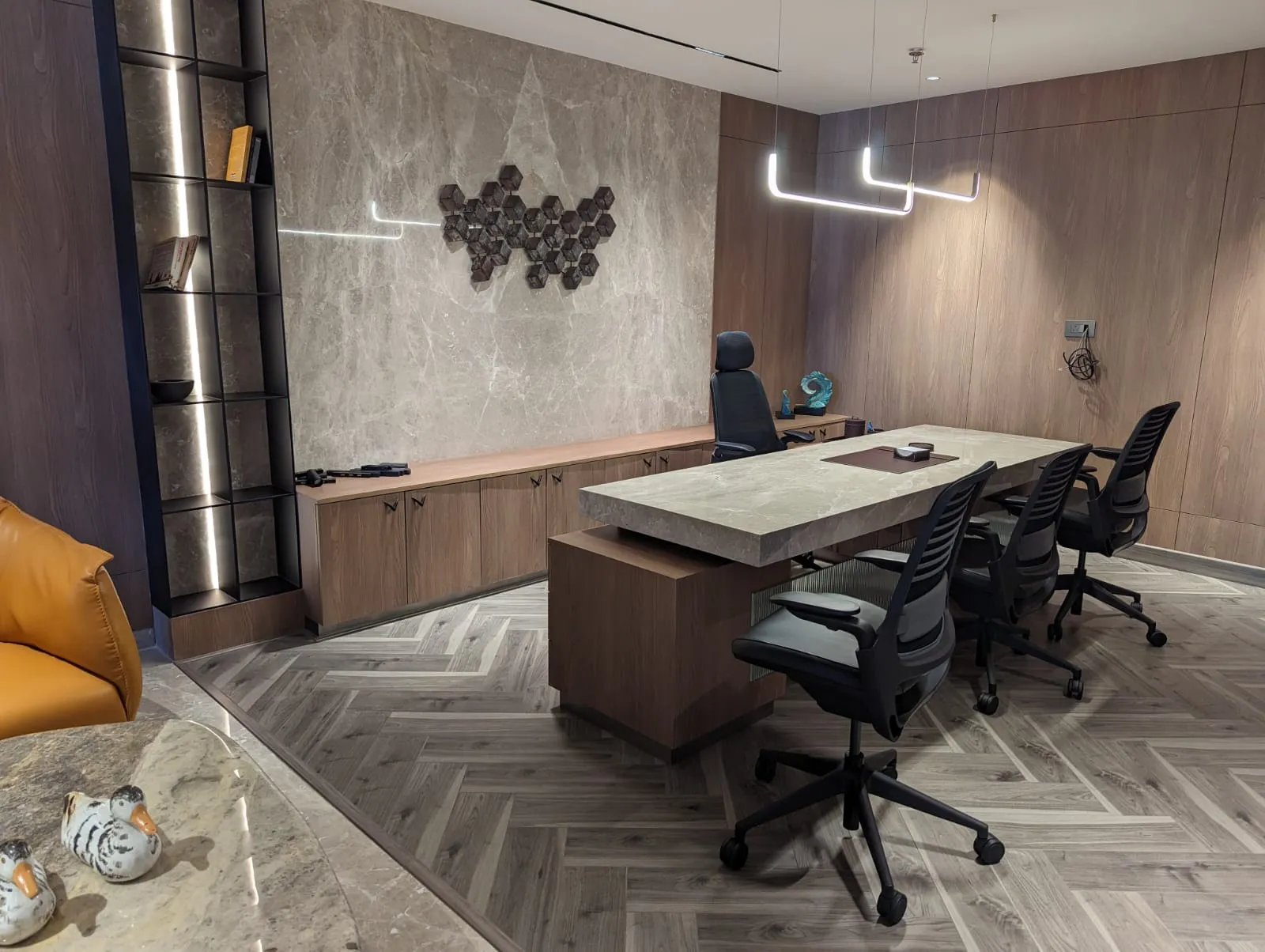
Executive cabins demand furniture balancing visual authority with storage. Selecting an executive office desk requires dimensions from 60x30 to 78x36 inches, with front overhangs allowing visitors to sit comfortably without hitting knees.
High-pressure laminates resist scratches, while 2mm PVC edge-banding bonded with hot-melt glue protects corners from impact. Pair executive desks with credenzas from our commercial furniture supplier selection to maintain unified finishes.
Cable Management and Integrated Technology Infrastructure
Loose power cords cause trip hazards and risk accidental disconnection. Specifying a dedicated cable management desk ensures wires route through under-surface raceways rather than trailing over work edges.
Horizontal raceways conceal power bricks, while flip-up aluminium boxes give desktop plug and USB access. Vertical articulated spines direct cables safely into floor boxes, keeping walkways wire-free.
Coordinating Front Office Desks and Meeting Tables
Visitors experience your workplace starting at the reception area. Choosing a custom reception desk with matching wood finishes establishes immediate credibility.
Meeting rooms require similar coordination, incorporating tables with central connectivity ports for conferencing displays and network lines. Explore our guide on selecting a conference room furniture supplier to coordinate table shapes and power access.
Certifications and Compliance Standards for Office Desks
Procuring commercial office furniture requires enforcing strict manufacturing standards. Consumer retail desks often wobble because joints lack industrial proof testing.
To safeguard capital investments, insist on four critical testing benchmarks:
- BIFMA X5.5 Mechanical Standards Structural testing verifying desk stability, proof load resistance, and leg drop impact strength under commercial use.
- Indoor Air Quality (IAQ) Low-Emission Verification that laminates and core boards emit near-zero volatile organic compounds (VOCs) for healthy air.
- Bureau of Indian Standards (BIS) Licensing Compliance with Indian manufacturing standards confirming structural safety, raw material integrity, and durability.
- ISO 9001, 14001, and 45001 Protocols International certifications ensuring consistent quality control, environmental sustainability, and workplace safety.
Requesting verified test certificates protects your organization against loose joints, wobbles, and premature replacement expenses.
How Nikshoo Engineers Scalable Desking Solutions
At Nikshoo, specifying office furniture follows a data-driven process that eliminates guesswork for facility heads and architects. Having furnished over 26,000 square feet across 50-plus corporate organizations, our team follows a four-step methodology:
- 1. Discovery and Spatial Consultation Our space planners assess floor dimensions, departmental headcounts, and circulation paths to create 2D and 3D layout plans.
- 2. Curated Product Exploration You evaluate commercial workstations, sit-stand systems, and executive desking tailored to your aesthetic theme and budget.
- 3. Certified Delivery and Installation Trained Nikshoo teams assemble, level, and wire every desk position on site according to the approved floor plan.
- 4. Ongoing After-Sales Maintenance We provide warranty support, spare parts availability, and modular reconfiguration support as your organization grows.
Whether supplying government projects through GeM or outfitting technology centres, Nikshoo manages every project through its structured four-step methodology, from initial spatial planning and product exploration to professional installation and after-sales maintenance, ensuring custom desking layouts enhance workflow connectivity, acoustic comfort, and long-term facility value.
Common Mistakes to Avoid When Choosing an Office Desk
Corporate workplace audits reveal recurring desk selection errors that result in physical discomfort and premature replacement expenses. The most common misstep is specifying insufficient desk depth. Desks measuring eighteen to twenty inches force monitors directly into the user's field of vision, causing eye strain while eliminating keyboard space. Equally disruptive is overlooking legroom clearance, where thick modesty panels or low drawers strike employee knees, preventing chairs from pulling in comfortably.
Technology integration and future flexibility create persistent operational challenges as well. Treating cable routing as an afterthought leaves power and network cords dangling across footwells, creating trip hazards. Choosing rigid, non-modular desks prevents facilities teams from reconfiguring layouts as company headcounts expand.
Finally, purchasing residential furniture from consumer retail outlets carries significant durability risks. Consumer tables lack heavy steel understructures and BIFMA X5.5 commercial testing, resulting in wobbly frames, damaged edge banding, and loose fasteners within months. Reviewing desk geometries and structural specifications before issuing purchase orders ensures long-term comfort and durable performance.
Conclusion: Invest in Desks That Support Your Team
Learning how to choose an office desk comes down to balancing proper dimensions, height ergonomics, clean wire routing, and certified structural durability. When your desks match your team actual daily tasks, employees work with less physical fatigue, cables remain neatly hidden, and your office retains its clean, professional character for years.
Whether you are furnishing a new corporate floor, setting up modular benching for a technology team, or upgrading executive suites with premium desking, Nikshoo provides the engineering precision and certified quality your facility deserves. Connect with our workspace design specialists today to plan your ideal office desk layout.
Frequently Asked Questions
The standard commercial office desk height is 29 to 30 inches (73.6 to 76.2 cm). This height accommodates most adult professionals when paired with an adjustable ergonomic chair that keeps feet flat on the floor with elbows at 90 degrees.
For general corporate tasks, an ideal workstation measures 48 to 60 inches wide and 24 to 30 inches deep. Developers, analysts, and designers utilizing dual monitors should have a wider surface measuring 60 to 72 inches in width.
Circulation walkways between desk clusters should measure 36 to 48 inches (91 to 122 cm) for two-way passage. Secondary aisles between facing desk rows require at least 36 inches to let chairs slide out without obstruction.
Yes. Electric dual-motor sit-stand desks allow employees to alternate between sitting and standing during the day. This posture shift relieves spinal compression, boosts alertness, and reduces absenteeism from musculoskeletal discomfort.
Modular benching workstations share structural legs and central wire raceways across adjoining seats, maximizing floor density and simplifying power routing. Standalone desks have independent frames, consuming more floor area.
Durable commercial desks use 25mm high-density pre-laminated boards finished with 2mm impact-resistant PVC edge-banding, supported by heavy-duty 1.2mm to 1.6mm steel understructures with electrostatic powder coating.
Check for BIFMA X5.5 structural stability testing, Indoor Air Quality low-emission standards, Bureau of Indian Standards (BIS) licensing, and ISO 9001, 14001, and 45001 management protocols for lasting durability.