
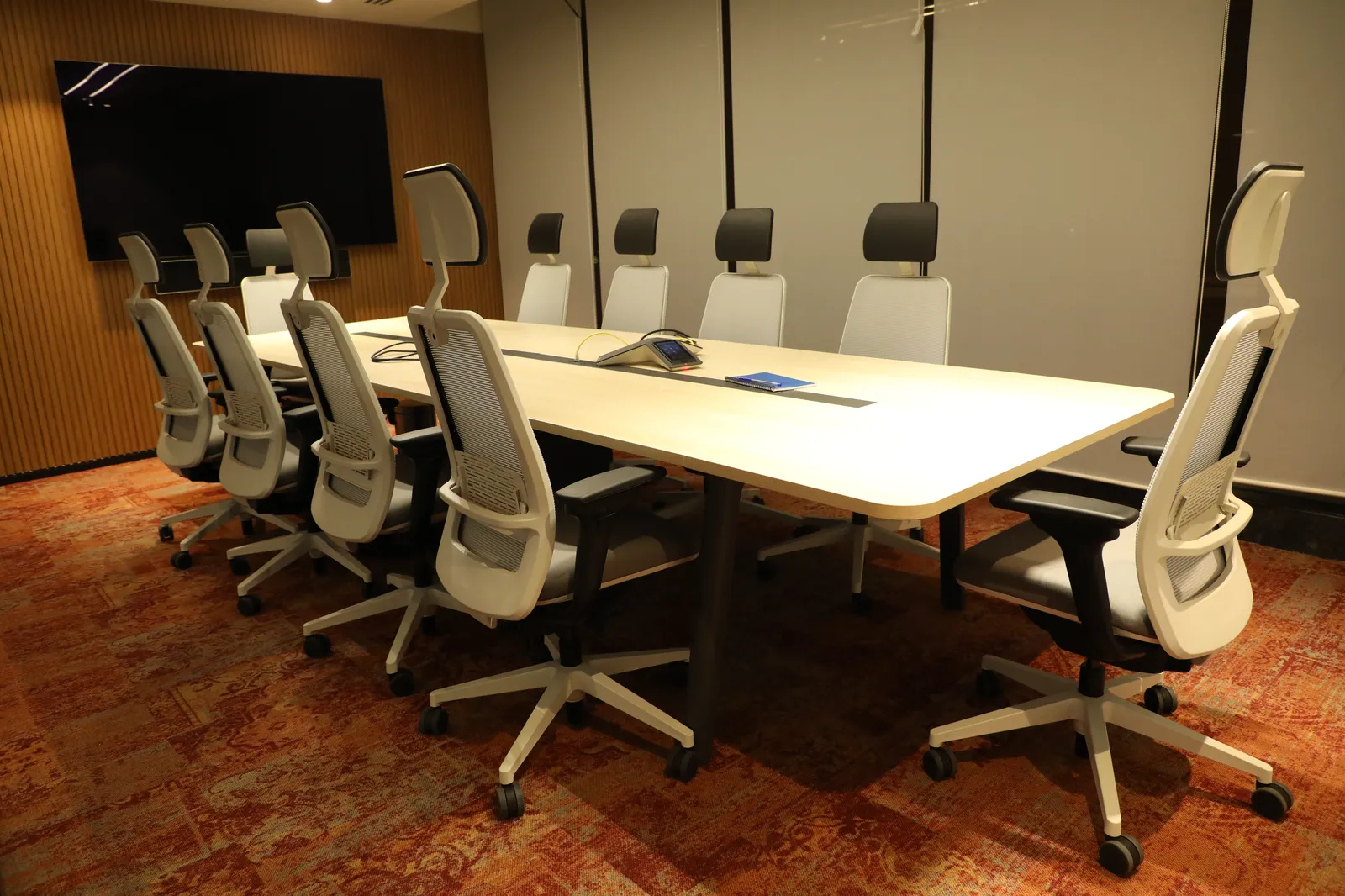
Walk onto any modern corporate floor, and the contrast between workstations and leadership suites is immediately visible in the seating. Open-plan bays feature taut mesh backs, while private corner offices feature imposing leather chairs.
When deciding between a mesh vs leather office chair for commercial facilities, the decision goes far beyond personal taste. Office seating dictates employee fatigue, workplace temperature comfort, daily cleaning protocols, and interior brand identity. Specifying the wrong upholstery for an eight-hour workstation leads to sweaty backs, restless posture adjustments, and premature fabric sagging within eighteen months.
This commercial seating guide breaks down thermal performance, foam ergonomics, upholstery lifecycles, and facility upkeep to help procurement heads choose the right office furniture for every workspace zone.
Strategic Evaluation: How Facility Teams Assess Office Seating
Commercial facilities operate across distinct zones with varied physical demands. An engineer coding for nine hours has different support needs than a director conducting short consultations.
Corporate facilities teams evaluate commercial office chairs across four operational dimensions:
- 1. Thermal Comfort and Airflow Assessing whether workspace density and room temperatures require open breathable weave to prevent heat accumulation.
- 2. Shift Duration and Task Intensity Evaluating whether employees sit for eight continuous hours on computational tasks or move between meeting rooms.
- 3. Cleaning Protocols and Hygiene Balancing quick liquid wipe-down convenience against deep-foam vacuuming requirements across facilities.
- 4. Spatial Aesthetics and Hierarchy Matching upholstery character to room purpose, from technical development bays to executive director suites.
Applying this assessment prevents costly mismatches. To understand broader seating fundamentals, review our guide on how to pick the best office chair before issuing vendor tenders.
Thermal Comfort: The Science of Airflow and Heat Dissipation
The human body radiates heat continuously. Seated against foam wrapped in solid vinyl or leather, heat gets trapped, causing skin temperatures to rise quickly.
A breathable office chair eliminates this thermal barrier. Suspended porous mesh allows air to circulate around backrests and thighs, maintaining neutral body temperature. In high-density IT campuses and shared call centres, deploying an ergonomic mesh chair keeps active teams alert and comfortable.
Ergonomic Contouring and Weight Distribution Mechanics
Static sitting places heavy pressure on sitting bones. How a chair distributes that load determines whether an employee finishes shifts comfortable or fatigued.
A responsive lumbar support office chair built with tensioned elastomeric weave cradles the natural lordotic spinal curve. High-tensile mesh adjusts to micro-movements without uneven foam compression. When paired with a synchronized tilt mechanism, a high-performance ergonomic office chair maintains pelvic alignment without pinching thighs.
Executive Cabin Seating: Visual Prestige and Deep Cushioning
While open workstations emphasize modular efficiency, executive suites require furniture reflecting leadership. A high back leather chair commands immediate respect, establishing an executive presence lighter task chairs cannot match.
Beneath the surface, a premium leather executive chair utilizes cold-cured moulded foam contoured for heavier postures. For meeting rooms, coordinating seating with tables from a dedicated conference room furniture supplier creates an impressive setting for board presentations.
Facility Maintenance: Hygiene, Spills and Surface Lifecycles
Housekeeping teams face different routines depending on upholstery. Spills and airborne dust degrade fabrics when left unaddressed.
A quality PU leather office chair allows cleaning staff to wipe surfaces clean with disinfectant cloths in seconds, making it popular in consultation rooms. Meanwhile, open-cell mesh prevents internal dust accumulation, simplifying routine office chair maintenance across large facilities.
Shift Duration and Work Habits: Mesh vs Leather Chair Comfort
Comfort is never uniform in offices. Employees engaged in data processing or coding lean toward screens, relying on backrest tension to prevent slouching.
For a deeper analysis of ergonomic mechanisms versus cabin seating, explore our comparison of an executive chair vs ergonomic chair to see how different tilt mechanisms support varied job functions.
Technical Comparison: Mesh vs Leather Office Seating
To assist procurement heads in making objective buying decisions, the following matrix compares commercial mesh against leather across six workplace metrics:
| Evaluation Factor | Mesh Office Chair | Leather Office Chair | Procurement Verdict |
|---|---|---|---|
| Airflow & Breathability | Outstanding continuous 360-degree ventilation | Minimal airflow; traps body warmth during long shifts | Mesh wins for hot climates & long shifts |
| Pressure Distribution | Dynamic elastomeric suspension flexes with spine | Plush multi-density foam cushion with initial softness | Both effective; mesh adapts dynamically |
| Spill & Stain Cleaning | Requires fabric spot cleaner or vacuuming | Wipes clean immediately with damp disinfectant cloth | Leather wins for quick surface hygiene |
| Executive Presence | Modern, technical, minimalist aesthetic | Commanding visual prestige with rich tactile texture | Leather wins for formal leadership cabins |
| Durability & Sagging | High-tensile mesh retains elasticity for years | High-grade leather ages well; cheap PU peels early | Tie if commercial BIFMA grade is chosen |
| Ideal Corporate Zone | Open plan workstations, BPOs, and tech benches | Executive suites, partner cabins, and boardrooms | Hybrid approach yields best office balance |
Understanding these differences enables facilities directors to source appropriate seating from a certified commercial furniture supplier without compromising ergonomics or design standards.
Commercial Standards and Durability Certifications
Office chair durability separates commercial seating from consumer retail models. In an active workplace, desk chairs undergo thousands of swivel rotations, recline cycles, and height adjustments annually.
To protect capital expenditure, ensure seating vendors comply with verified standards:
- BIFMA X5.1 Office Seating Standards Mechanical testing covering chair drop strength, backrest durability, swivel cycling, and caster stability.
- BIFMA LEVEL Sustainability Certification Evaluation of environmental materials, chemical emissions, and manufacturer corporate responsibility.
- Indoor Air Quality (IAQ) Low-Emission Testing Verification that foam adhesives and synthetic mesh release near-zero volatile organic compounds.
- Bureau of Indian Standards (BIS) Licensing Mandatory quality certification ensuring products supplied in India meet structural safety codes.
Working with a certified BIFMA certified office chair supplier guarantees that gas cylinders, star bases, and tilt mechanisms satisfy rigorous durability and structural safety mandates.
Coordinating Seating with Modular Desks and Workstations
An exceptional chair cannot compensate for an ill-fitting desk. Chairs with fixed armrests collide with drawers or modesty panels, forcing users to lean forward.
Reviewing our comprehensive guide on how to choose an office desk ensures your desks, sit-stand units, and seating geometries support healthy posture across departments.
Nikshoo Seating Solutions: Engineering Enterprise Workspaces
At Nikshoo, we provide a balanced seating ecosystem. Rather than forcing one chair model across departments, our space planners deploy breathable mesh for active teams and executive leather for leadership spaces effectively.
- 1. Discovery and Spatial Consultation We evaluate departmental work patterns, shift durations, and room cooling to determine the optimal chair mix.
- 2. Curated Product Exploration Clients review material swatches, test sample ergonomic mesh and leather units, and evaluate mechanism options within budget.
- 3. Certified Delivery and Assembly Trained Nikshoo technicians assemble and inspect every chair position, ensuring tilt tensions, gas lifts, and armrests operate smoothly.
- 4. Dedicated After-Sales Maintenance We back every corporate deployment with warranty coverage, rapid spare parts supply, and modular servicing across India.
With over fifteen years of experience and GeM-registered credentials, Nikshoo delivers certified commercial furniture that supports employee health and productivity.
Common Procurement Mistakes to Avoid in Chair Selection
Corporate workplace audits reveal recurring errors leading to premature replacement cycles. The most frequent misstep is purchasing low-grade stretched nylon mesh. While budget task chairs look acceptable initially, substandard weaves lose tensile strength under daily loads. Within months, the backrest forms a sagging pocket that fails to support the lumbar spine.
A second mistake involves selecting thin bonded synthetic leather for open workstations or humid regional offices. Low-grade coatings degrade quickly under sweat and humidity, causing premature peeling. Facility teams also overlook seat edge design. Rigid front frames compress thigh circulation, making waterfall contours and supportive seat pans essential.
Purchasing uncertified retail furniture instead of commercial grade seating carries serious structural risks. Consumer models lack BIFMA X5.1 cycle testing required for multi-shift use, resulting in failed gas cylinders and broken casters. Imposing one material across all zones creates friction. Deploying breathable mesh for workstations while reserving executive leather for boardrooms ensures each area fulfills its purpose.
Conclusion: Finding the Right Seating Mix for Your Workplace
Choosing between a mesh vs leather office chair comes down to balancing functional ergonomics with spatial intent. For general staff bays, hot-desks, and technical development pods, breathable mesh provides thermal relief and dynamic spinal support for daily screen work. For leadership cabins and conference spaces, premium leather delivers visual prestige, plush cushioning, and easy sanitation expected in executive settings.
Balancing functional ergonomics with spatial intent allows organizations to deploy breathable mesh for active teams and executive leather for leadership spaces effectively. At Nikshoo Furniture Solutions, we guide corporate clients through every stage of commercial furniture selection, ensuring each chair investment supports team health and organizational prestige. Connect with our corporate seating specialists today to request product samples and plan your workspace seating.
Frequently Asked Questions
For continuous eight to ten-hour desk work, an ergonomic mesh chair is generally superior because open weave promotes airflow and prevents heat build-up. For managerial roles involving intermittent sitting and visitor discussions, a leather executive chair with dense moulded foam provides deep, comfortable cushioning.
Commercial mesh chairs engineered with elastomeric polyester weaves resist sagging across five to ten years. In contrast, cheap consumer nylon mesh can lose tension within twelve months, eliminating lower back support. Always verify BIFMA X5.1 durability ratings before purchasing.
In unconditioned or humid spaces, leather can induce sweating by restricting airflow. However, leather wipes clean easily after spills. In climate-controlled offices, leather performs comfortably and requires only occasional damp-cloth cleaning and conditioning.
Genuine leather is made from natural hide, offering high durability, natural breathability, and rich aging. PU (polyurethane) leather is a synthetic alternative offering similar executive aesthetics and easy wipe-down sanitation at a lower procurement cost.
Routine maintenance involves regular vacuuming with a soft brush attachment to remove airborne dust trapped in the weave. Light stains can be spot-treated using mild detergent, warm water, and a microfiber cloth, avoiding abrasive chemicals that weaken fibers.
Yes. Hybrid task chairs combine a breathable mesh backrest with a contoured high-density foam seat upholstered in leather or commercial fabric. This provides ventilated back cooling alongside familiar padded seat cushioning.
Verify compliance with BIFMA X5.1 mechanical safety standards, Indoor Air Quality low-emission benchmarks for low VOC emissions, Bureau of Indian Standards (BIS) licensing, and ISO 9001 and 14001 management protocols.