
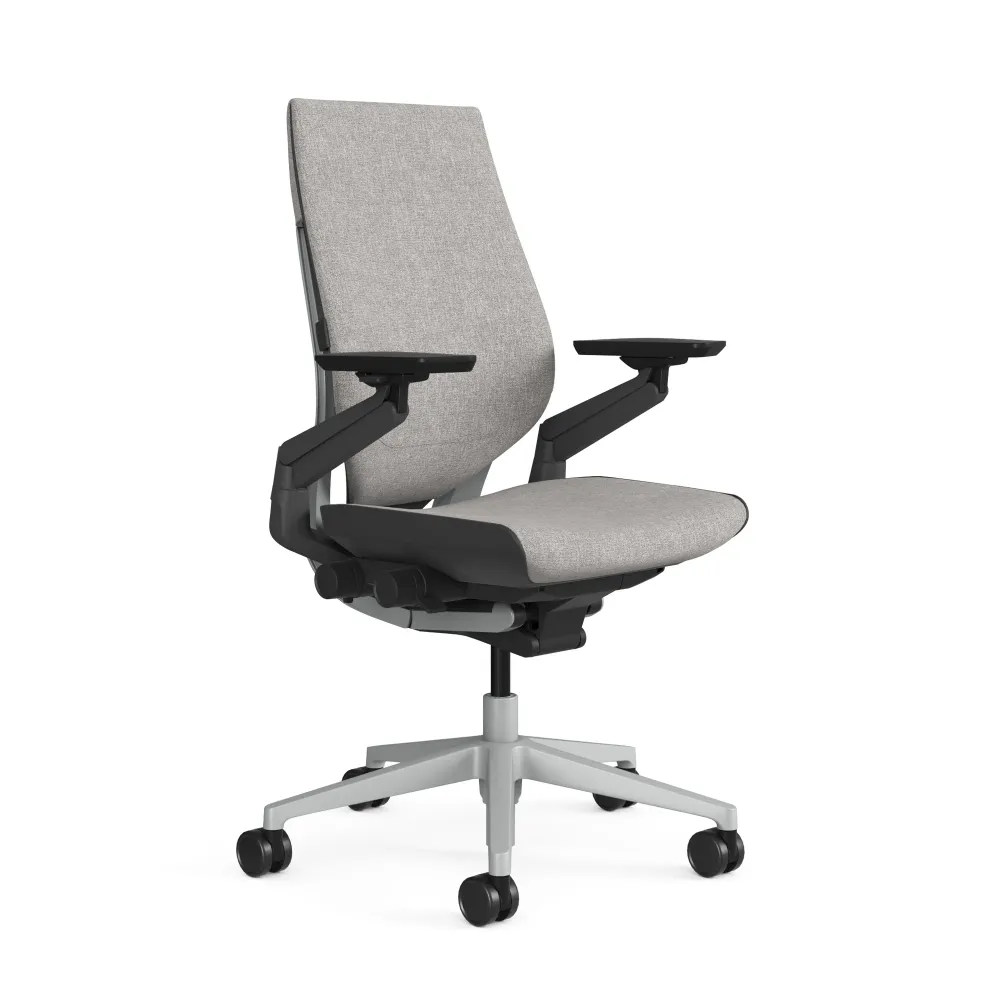
Two office chairs can look nearly identical in a showroom and feel worlds apart by five in the evening. The difference sits in the engineering you cannot see at first glance: how the backrest flexes with your spine, how the tilt mechanism keeps your eyes on your screen, and how the seat cushion distributes weight. That is where Steelcase chair features set a different benchmark.
So what makes Steelcase office chairs different from other ergonomic chairs? Steelcase builds every work chair around three pillars: Innovative Design backed by 18 seating studies and over 2,700 global patents, Dynamic Comfort that solves for Movement, Connection and Fit, and Broadest Choice across 195 seating products. Features like LiveBack technology, Natural Glide, Weight Activated Synchro Tilt, Adaptive Bolstering and 360 degree or 4D arms move with your body.
This guide explains every feature across the Gesture, Karman, Leap, Think, Series 2, Series 1 and Personality Plus, covers how Steelcase tests 95 percent in house manufactured chairs across over 100 quality checks, and shares the official showroom test checklist. Nikshoo supplies complete office furniture and installs genuine Steelcase seating from our Indore showroom.
Steelcase Chair Features at a Glance Across All Seven Models
Before comparing individual chairs, it helps to see how the main engineering systems map across the task seating range. Steelcase organises its task portfolio around seven models: Gesture, Karman, Leap, Think, Series 2, Series 1 and Personality Plus. Use this table to match each feature to the model that carries it.
| Steelcase Feature | What It Solves | Models With This Feature |
|---|---|---|
| 3D LiveBack, Core Equalizer | Full spinal motion and lower back firmness in recline | Gesture |
| LiveBack, Firmness Control | Holds natural S curve with dialled lower back support | Leap, Karman |
| LiveBack Flexor System | Flexible back frame and flexors follow the spine | Think, Series 1 |
| Air LiveBack, Waterfall Mesh | Two way geometric flex or Italian Air mesh back | Series 2, Personality Plus |
| Manual Synchro, Natural Glide | Seat glides forward in recline to keep work in reach | Leap, Gesture |
| Weight Activated Synchro Tilt | Sets recline tension from body weight, with boost lock | Karman, Think, Series 2, Series 1, Personality Plus |
| 360 Degree and 4D Arms | Arms adjust in four directions or 360 degrees | Gesture (360), others (4D) |
| Adaptive Bolstering, Hybrid Seat | Foam coring with air pockets or suspended cushion | Foam seats, Karman |
| Passive and Comfort Seat Edge | Flexible front edge bends to relieve thigh pressure | All seven models |
The Steelcase Seating Difference: Dynamic Comfort and Choice
A standard ergonomic chair gives you a stiff backrest, a flat cushion and a few levers underneath. Steelcase builds its chairs around the Steelcase Seating Difference framework: Innovative Design, Dynamic Comfort and Broadest Choice. Since 2000, the company has completed 18 seating studies and earned over 2,700 global seating patents across the Steelcase Family of Brands since 1942.
Unlike brands that buy generic mechanisms from outside factories, Steelcase designs, engineers and manufactures 95 percent of its brand seating in house. Its portfolio spans 195 Steelcase brand seating products and more than 19 partner options, covering every workspace style and materiality preference. For baseline checks before comparing brands, read our guide on how to pick the best office chair.
Dynamic Comfort: Cervical, Thoracic and Lumbar Spine Support
When you stand naturally, your spine holds a healthy S curve across the cervical, thoracic and lumbar regions. Once you sit at a desk and lean toward a screen, the pelvis rolls backward and that S curve collapses into a slumped C posture. Dynamic Comfort looks past the first minute you sit down and keeps all three spinal regions supported through Movement, Connection and Fit.
Movement Features: LiveBack, 3D LiveBack and Spine Support
Movement is powered by LiveBack technology, which lets the backrest flex to mimic the natural motion of your spine. Leap and Karman use LiveBack to hold the natural S curve, with a Lower Back Firmness Control dial on the Leap. Gesture pairs 3D LiveBack with a Core Equalizer, Think and Series 1 use a LiveBack Flexor System, Series 2 uses a two dimensional Air LiveBack pattern, and Personality Plus uses a waterfall Italian Air mesh back.
Connection Features: Synchro Tilt, Natural Glide and Recline
In a standard chair, leaning back lifts the front of the seat and pulls your hands and eyes away from your desk. Steelcase proprietary mechanisms move the seat and backrest together so your arms stay parallel to the floor in the ideal vision and reach zone. Leap adds the Natural Glide System so the seat slides forward in recline, Gesture uses an Advanced Synchro Tilt, and the other five models use Weight Activated Synchro Tilt mechanisms.
Fit Features: Adaptive Bolstering, Flexible Edges and 4D Arms
Steelcase designs task seating to fit users from the 5th to the 95th percentile. Inside the cushion, Adaptive Bolstering uses foam coring and infused air pockets that compress under the sit bones to spread weight evenly, while a Passive Seat Edge flexes under the thighs to relieve pressure. Gesture features 360 degree arms on a limb interface, while the other models feature 4D arms, seat depth adjustment, optional headrests, and English and braille labels on the Leap.
How Steelcase Chair Features Work in Gesture, Leap and Karman
The Task Portfolio Positioning chart shows what drove each flagship chair. Gesture was built for posture shifts caused by mobile technologies across individual and shared desks, combining 3D LiveBack, Core Equalizer, 360 degree arms and a soft plastic plastometer seat edge with immediate seat depth feedback. Leap was built for focused work needing high adjustability, pairing LiveBack and Lower Back Firmness Control with Natural Glide. Read our best steelcase chair for long hours guide to compare them.
Steelcase Karman delivers comfort and sustainability in a new way for warm floors. It suspends proprietary Intermix performance textile on a light flexing frame so the seat and back never sag or feel stiff. Its Patented Hybrid Seat integrates cushioning with suspension, while the flexing Comfort Edge removes hard borders against your legs and body. Compare mesh and upholstered seating in our mesh vs leather office chair guide.
Features in Think, Series 2, Series 1 and Personality Plus
For agile workspaces and large floors, the other four task chairs deliver core Steelcase chair features in lighter profiles. Think suits mobile workplaces with its LiveBack Flexor System and Weight Activated Synchro Tilt, while Series 2 brings two dimensional Air LiveBack technology to mid market spaces. Series 1 packs a LiveBack Flexor System, 4D arms and Passive Seat Edge into a compact frame, and Personality Plus adds a waterfall Italian Air mesh back, boost lock and Fluid 4D arms.
Quality Testing, 24/7 Warranty and Circular Sustainability
Under Innovative Design, quality is verified in the testing lab. Because Steelcase designs and manufactures 95 percent of the chair itself, it runs more than 80 additional durability tests on top of the 20 required industry standard tests. That supports a 12 year warranty covering 24/7 use on parts and labour and yields the lowest warranty claims in the industry. See our BIFMA certified office chair supplier guide for test paperwork tips.
Sustainability spans three stages across the product life cycle. First, Steelcase selects responsibly sourced materials that support human and environmental health. Second, minimal and circular design uses fewer parts for rapid disassembly and recycling. Third, end of use strategies mean products are tested and designed to last twice the warranty period before being repurposed through donation or recycling.
Showroom Checklist: How to Test Steelcase Chair Features
When you visit a showroom to evaluate Steelcase chair features, use the official questions from the Steelcase Seating Difference guide. Bring your laptop, sit in your normal working posture for at least ten minutes, and check these four points before you place a bulk or individual order.
- 1. Experience Movement: Backrest Shape Does your backrest change shape as you recline or shift posture, and can you sit in varied postures without feeling restricted?
- 2. Experience Movement: Resistance Can you reach a comfortable level of back resistance without feeling you are falling back or being pushed forward?
- 3. Experience Connection: Vision and Reach Do your arms stay parallel to the floor and level with your work surface in recline, keeping your eye line on your work?
- 4. Experience Fit: Seat Edge and Controls Does your seat include flexible edges, does it feel supportive, and was it easy to find and understand all adjustments?
Even the best chair needs a proper desk height and monitor distance to prevent strain across a long shift. When planning a full floor, pair your task chairs with modular desks and cable routing as explained in our workstation furniture supplier guide, so seating and workstations work together.
Buying Steelcase Office Chairs in India From Nikshoo
Nikshoo Furniture Solutions has supplied commercial workspaces for over fifteen years and completed more than 100 projects for clients such as SBI, HSBC and IIM Bangalore. As an official Steelcase dealer in Indore and a registered GeM seller, we handle floor planning, showroom sit tests, delivery and installation from 20 Dhenu Market Road. Visit our ergonomic chair supplier page to view our seating range and match the right model to your floor.
Common Mistakes When Comparing Ergonomic Chair Features
The first mistake is judging a chair by pillowy softness in a one minute test, since soft foam lets your pelvis slump whereas Adaptive Bolstering supports your sit bones all day. A second mistake is buying a bulky executive chair for typing work, which lacks synchro tilt connection and 4D arms, as our executive chair vs ergonomic chair guide explains. On shared desks, weight activated models beat multi lever chairs, and buying from an authorised dealer protects your warranty.
Conclusion: The Steelcase Chair Features Worth Paying For
Across the Gesture, Karman, Leap, Think, Series 2, Series 1 and Personality Plus, Steelcase chair features work together to solve for Movement, Connection and Fit. Backed by 18 seating studies, over 2,700 global patents, 95 percent in house manufacturing and more than 100 quality tests, these chairs keep your spine supported all day. Contact Us to book a visit to our Indore showroom, and our team will set up a test sit for you.
Frequently Asked Questions
The main Steelcase chair features solve for Movement, Connection and Fit: LiveBack, 3D LiveBack, Flexor and Air LiveBack backrests for the spine; Manual Synchro Tilt with Natural Glide and Weight Activated mechanisms for desk connection; and 360 degree or 4D arms, Adaptive Bolstering and Passive or Comfort seat edges.
Steelcase chairs follow the Steelcase Seating Difference framework: Innovative Design backed by 18 seating studies and over 2,700 patents, Dynamic Comfort that keeps your spine moving and your arms parallel to the floor in recline, and 95 percent in house manufacturing verified across over 100 quality tests.
LiveBack adapts to each model. Leap and Karman use contoured LiveBack to hold the natural S curve of the spine, Gesture uses 3D LiveBack with a Core Equalizer, Think and Series 1 use a LiveBack Flexor System, and Series 2 uses a two dimensional Air LiveBack pattern.
Natural Glide on the Steelcase Leap is a manual synchro tilt mechanism where the seat slides forward as you recline, keeping you in the vision and reach zone. Weight Activated Synchro Tilt on Karman, Think, Series 2, Series 1 and Personality Plus sets recline tension from your body weight.
Adaptive Bolstering is intentional coring with infused air pockets inside the seat foam that compresses under your sit bones to spread weight across user sizes. Passive Seat Edge is a flexible front border that bends under your thighs when you lean or recline to relieve pressure.
Steelcase designs and manufactures 95 percent of each chair in house and runs over 80 extra quality tests on top of 20 standard tests. Chairs carry a 12 year 24/7 warranty, use responsibly sourced materials and fewer parts for recycling, and last twice the warranty period.
Nikshoo Furniture Solutions is an official Steelcase dealer in Indore at 20 Dhenu Market Road, open Monday to Saturday from 10 AM to 7 PM. You can test the Gesture, Leap, Karman, Think and Series chairs in person, and our team handles delivery and installation.